Collision Estimate Terms, Explained: R&I, Blend, Pre-Scan and More
Collision estimate terms are the short codes on a body shop estimate or an insurance appraisal that say what happens to each part of your car. R&I means a part comes off and goes back on, REPL means it is replaced, REP means it is repaired, and Blend means new paint is faded into the panel next to it.
Below are 45 terms you are likely to see, grouped the way an estimate reads: parts and labor, the totals, paint, prep and finishing, then scans and mechanical checks. Search for a code, or tap one in the example estimate to jump straight to it.
In the middle of a claim? Our insurance collision claims page explains how we work with your insurer, and our collision repair page covers the repair itself.
What Does a Collision Estimate Look Like?
Every line on an estimate pairs an operation code with a part. Here is how a few lines might read after a front-corner hit. Tap a code to see what it means.
| Oper | Description |
|---|---|
| R&I | Front bumper cover |
| REPL | Headlamp assy, left |
| REP | Fender, left |
| Refinish | Fender, left |
| Blend | Front door, left |
| Pre Scan | Pre-repair scan |
| Calibrations | Front radar calibration |
| Wheel Alignment | Four-wheel alignment |
Illustrative example, not a real customer estimate. Hours are left off on purpose: labor and paint times change with every car, every repair and every estimating system.
No term matches that. Call (781) 470-0707 and ask us.
Parts and Labor Codes: R&I, R&R, REPL and REP
These codes tell you what happens to each part: taken off and put back, fixed, or swapped for a different one.
R&I Remove and Install
A part comes off, gets set aside, then the same part goes back on. It is usually moved to reach, fix or paint something next to or behind it. The line itself is labor.
Many repairs need nearby parts, like a bumper cover or lamp, out of the way first.
R&R Remove and Replace
Your damaged part is taken off for good and another part is installed in its place. That replacement may be new from the carmaker, new from another maker, or used. The estimate says which.
It marks parts too damaged to fix. Labor hours and part price sit in separate columns.
REPL Replace
The same job as R&R: the damaged part is swapped for a different one. CCC ONE prints it as Repl. Other systems may say Remove/Replace. It is one operation, not a second charge.
Different estimating systems use different labels for the same job.
REP Repair
Your original part stays and gets fixed, such as pulling and smoothing a dent. The estimator sets the hours based on the damage. Paint is usually a separate line. Often printed as Rpr.
Fixing a part can cost less than replacing it when the damage allows.
O/H Overhaul
A whole assembly, such as a bumper, comes off, gets taken apart, cleaned, checked, put back together and reinstalled. One labor time covers it. New pieces it needs are priced on their own lines.
Used when most attached pieces must come off anyway, instead of listing each one.
Assy Assembly
A group of parts that work together and are sold or handled as one unit, like a complete headlamp. A line marked Assy covers the whole unit, not one piece.
Some parts are only sold as a full unit, so the whole unit gets priced.
Research Repair Research
Time spent looking up the carmaker’s official repair steps for your exact vehicle: how parts come off, which pieces cannot be reused, and which scans or calibrations it calls for.
Estimating guides do not include lookup time, so it can appear as its own line.
Documentation
Recording the damage and the repair with photos, measurements and printouts, such as computer scan reports. It gives you, the shop and the insurer a clear record of what was found and done.
Insurers often ask for proof of damage and repairs before approving or paying.
Adding It Up: Overlap, Deductions and Supplements
These lines explain how the hours and dollars are counted, what gets taxed, and what happens when more damage turns up.
Overlap
When two neighboring parts are both worked on or painted, some of the time is shared, like a seam both jobs touch. That shared time is taken off so it is not charged twice.
It lowers the labor total. It does not mean any work was skipped.
Deductions
Time or money taken off. On a labor line, it is time already counted elsewhere. In the totals, it can be your share, like a deductible. That lowers the insurer’s payment, not the repair cost.
Some estimates label the totals part Adjustments or Customer Responsibility instead.
Taxable Items
The lines that sales tax is added to, usually parts and paint materials. The estimate marks which lines are taxable, so you can follow how the tax total was figured.
Not every line is taxed, so the estimate separates the ones that are.
Supplement
A second estimate for hidden damage found after parts come off. Your insurer reviews it. In Massachusetts, the insurer’s appraiser is generally required to inspect the car within 3 business days after the insurer gets the request (212 CMR 2.04(1)(h)).
Some damage only shows once the car is apart, so the first estimate may not cover everything.
Paint and Color Terms: Refinish, Blend and Clear Coat
Paint lines cover the color work itself and the steps it takes to match the shade already on your car.
Refinish Refinish (paint labor)
The paint work on a part: cleaning and sanding it, sealing if needed, then color and clear coat. Refinish hours are paint labor, listed apart from body repair hours.
Most repaired or replaced body panels need paint, so each gets a refinish line.
Blend Color blend
The new color is faded into the undamaged panel next to the repaired or replaced one. Paint shades vary, so this helps avoid a visible line where new paint meets old.
It explains why a panel with no damage still shows paint labor.
Clear Coat
The see-through, glossy top layer sprayed over the color. It gives the shine and helps protect the color underneath from sun and weather.
Many estimating systems list clear coat as its own time, added on top of the color paint time.
2 Stage Two-stage paint (basecoat/clear coat)
The standard finish on most cars today: a color layer, called basecoat, with a clear coat on top. The estimate names the paint type so the right steps and time are used.
The paint type decides whether clear coat time is added.
3 Stage Three-stage paint (tri-coat)
A base color, then a see-through pearl or effect layer, then clear coat. Also called tri-coat. It takes extra steps to match, so estimates usually add labor for it.
Common on pearl whites and some reds. The extra layer adds paint time.
4 Stage Four-stage paint
One more layer than three-stage, such as an extra ground coat or a tinted clear coat. Which layers it uses depends on the car’s color and the paint brand.
A few specialty colors need it. The same color may be listed as 3 or 4 stage by different paint brands.
Edges Edge refinish (edging)
Edges are the outer rims and folded-over lips of the part itself. On a new part they are often painted before it goes on the car. Standard panel paint time may not include them.
Common on new replacement parts, whose edges need paint before they go on.
Undersides Underside refinish
The underside is the inner or back surface of a part like a hood or trunk lid, the side you see when it is lifted. A new replacement part may need this side painted too.
Standard paint time covers the outside face, so the underside is listed when it needs paint.
Jambs Jamb refinish
Jambs are the painted areas you only see with a door, hood or trunk open: the frame around the opening and the inner faces of the part. This line covers painting them.
These hidden areas are not part of the panel’s outside paint time, so they get their own line.
Tint Color tinting
Fine-tuning the paint mix with small amounts of color so the new paint comes closer to your car’s current shade, which can shift with age and sun. It can take several rounds.
Standard paint times do not include extra tinting, so it may be listed separately.
Spray Out Card
A small test card painted with the mixed color and clear coat. The painter compares it to the car in good light, from several angles, before painting the car.
Making and checking the card takes time that standard paint hours may not include.
Test Panel Test panel (let-down panel)
A practice piece sprayed before the real work. For three-stage colors it is sprayed in strips with different numbers of effect coats, to see which count matches the car.
Most often seen with three- and four-stage colors, where the number of layers changes the final shade.
Prep and Finishing Terms on a Paint Estimate
Before and after the paint goes on, the car is cleaned, covered and polished, and these lines cover that work.
Pre-Wash Vehicle
Washing the car before repairs start to remove dirt, salt and road grime. A clean car shows all the damage, shows the true paint color for matching, and keeps dirt out of new paint.
Washing is not built into body or paint labor time, so it shows up as its own line.
Car Cover 1, 2, 3 Car Cover (vehicle bagging for overspray)
The whole car is covered in a thin plastic cover so paint mist, called overspray, does not land on glass, trim or other panels. Numbered lines can mean the cover went on more than once.
Paint time usually covers masking right around the panel. Covering the whole car on top of that is a separate step.
Mask Jambs for Paint
Before painting, the inside of the door or trunk opening is covered with tape and paper or plastic. This keeps paint mist off seals, trim and the interior.
Standard paint time covers basic outside masking only. Inside masking is a separate step.
Masking Tape Masking Tape (masking materials)
Paint-safe tape that covers trim, glass and nearby panels that should not get paint. Basic masking is usually built into paint labor, so this line is often the tape itself or extra masking.
Masking supplies are materials, so they can be listed apart from paint labor hours.
Foam Tape Foam Tape (soft-edge foam masking tape)
Soft foam tape pressed into the gaps around doors, hood and trunk. It keeps paint mist out of the openings and leaves a soft paint edge instead of a sharp tape line.
Foam tape is a material, so it can be listed apart from the masking labor.
Flashing Off Flash-Off (flash time between coats)
The short wait between coats of primer, paint or clear coat so solvent or water can partly evaporate. It is not full drying. Paint makers set these times.
CCC paint labor does not include the wait between coats, so it is judged job by job.
Flex Additive Flex Additive (flexible additive)
An ingredient mixed into primer or clear coat for flexible plastic parts like bumper covers, so the paint bends with the part instead of cracking. Paint makers say when their system needs it.
It is an extra material, and a bumper painted with it is often done as its own step.
C S & B Color Sand and Buff
After the new clear coat cures, the panel is wet-sanded with very fine sandpaper, then machine polished. This smooths texture and small flaws so the new finish looks closer to the paint around it.
Also called Finish Sand and Buff, Rub-Out and Buff, or Final Sand and Buff. Estimating systems usually list it apart from basic paint labor.
Denib De-nib (nib sanding)
Removing tiny dust specks that settled in fresh paint by lightly sanding and polishing just those spots. It is a spot fix, smaller than buffing a whole panel.
Also listed as De-Nib and Polish or De-Nib and Finesse. A little dust can land in wet paint in any shop, and this line covers removing it.
Scans, Calibrations and Mechanical Lines
Computer checks, sensor calibrations and mechanical items that help bring the car’s systems back to how the carmaker set them.
Pre Scan Pre-Repair Scan
A computer check before repairs start. It reads the fault codes your car’s computers have saved, including problems that never turn on a dash light, so they become part of the repair plan.
Modern cars can have electronic damage you cannot see, and many carmakers call for this check after a collision.
In Process Scan In-Process Repair Scan
A computer check partway through the repair, often after parts go back on and before any calibration. It catches new fault codes so they can be fixed before the final check.
Unplugging and replacing parts can set new fault codes that need fixing before sensors are calibrated.
Post Scan Post-Repair Scan
A computer check after repairs are done. It shows whether fault codes from the collision, or set during the repair, have been fixed. Some codes only show up after a test drive.
It is one of the last checks before your car goes home, and many carmakers call for it.
ADAS Advanced Driver Assistance Systems
Driver-assist features such as emergency braking, lane keeping, blind spot warning and adaptive cruise. They help the driver but do not drive the car. A collision or repair can knock their sensors out of aim.
It usually appears next to scan or calibration lines for sensors near the damaged area.
Calibrations Sensor Calibration
Setting a camera or radar so it aims where the car’s computer expects. Often needed after collision damage, windshield or bumper work, or an alignment. Some calibration lines are for other sensors, like steering angle.
A sensor can be off with no warning light, so the carmaker’s procedure decides when one is needed.
Static Static Calibration
A calibration done with the car parked on a level floor. Targets are set at exact distances and angles, and a scan tool has the sensor set its aim to them.
Many cameras and radars are set this way after repairs. Tire pressure and ride height are set first.
Dynamic Dynamic Calibration
A calibration done by driving the car on real roads, at the speeds and road conditions the carmaker lists. A scan tool usually starts it, and the sensor sets its own aim while driving.
Some cars need it, alone or after a static calibration. Weather and traffic can change how long it takes.
Wheel Alignment
Measuring and adjusting the angles of the wheels to the carmaker’s specs, so the car drives straight and tires wear evenly. Bent suspension or steering parts are replaced first, because an alignment cannot correct them.
A hit to a wheel can change these angles with no visible damage. Some cars then need a calibration.
Tire Pressure Tire Pressure Check and Adjust
Checking each tire’s air pressure and setting it to the carmaker’s recommended number. That number is usually on a sticker in the driver’s door frame, not the maximum printed on the tire.
Correct pressure matters for driving and is set before alignments and calibrations.
Fluid Top Off
Refilling fluids that ran low or were lost in the collision or during repairs, such as coolant or washer fluid, back to the correct level.
Fluids can leak out when parts are damaged or disconnected during the repair.
EVAC A/C Evacuate (part of Evacuate and Recharge)
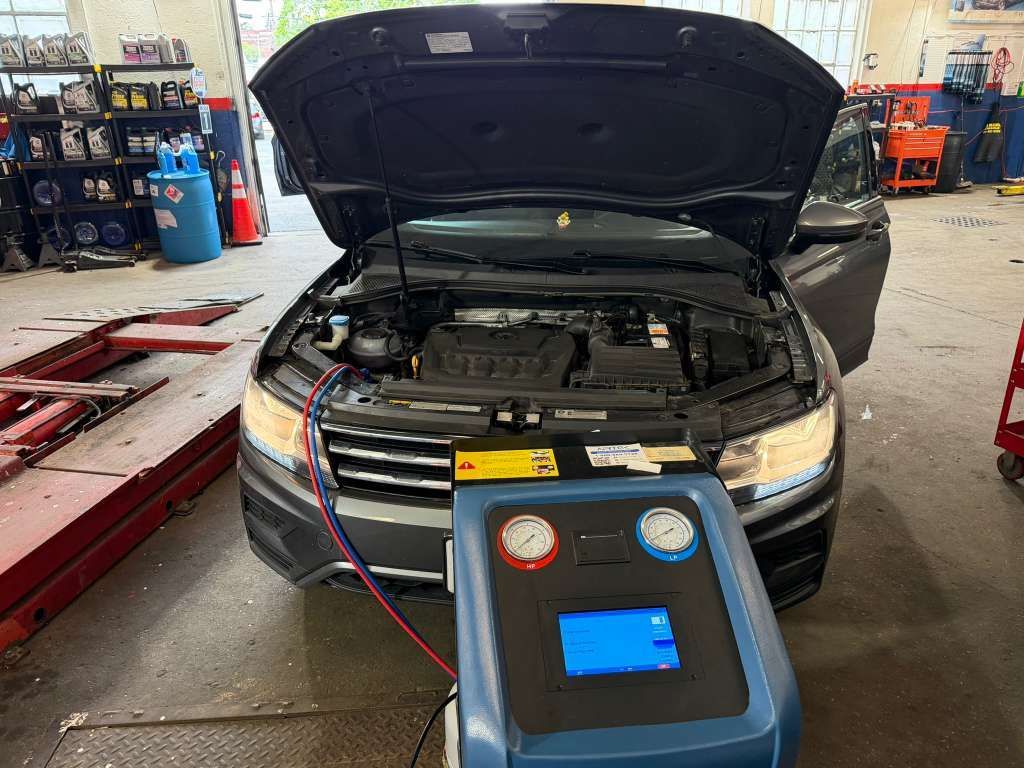
Short for evacuate. Recovery equipment captures the refrigerant, the A/C gas, as federal rules require, so the A/C system can be opened. Before refilling, a vacuum pulls out air and moisture.
A/C parts at the front of the car, like the condenser, are often damaged in collisions.
Recharge A/C Recharge
Refilling the A/C system with the exact type and amount of refrigerant the carmaker specifies, usually shown on a label under the hood. It is done after the repair and the vacuum step.
After A/C parts are replaced or the system is opened, it must be refilled to work.
Frequently Asked Questions
Why is a panel with no damage on my estimate?
That is usually a blend. Paint shades vary a little from car to car and fade with sun and age. To avoid a visible line where new paint meets old, the painter fades the new color into the panel next to the repair. That takes paint time, so the panel gets its own line.
Why are scans and calibrations on my estimate for a small hit?
Many cars today have computers and sensors in bumpers, mirrors and windshields. A scan before and after the repair reads fault codes, including ones that never light up the dash. If a camera or radar near the damage was moved, the carmaker’s procedure may call for a calibration so it aims where it should. NHTSA has a plain-English overview of these driver assistance technologies.
What is a supplement, and why did I get one?
Some damage only shows once parts come off, like a cracked bracket behind the bumper. When that happens, a supplement is written: a second estimate for the added work, sent to your insurer for approval. In Massachusetts, the insurer’s appraiser is generally required to inspect the car within 3 business days after the insurer gets the request. We will tell you what we found and get your OK before doing the added work.
Is the shop estimate the same as the insurance appraisal?
Not always. Your insurer’s appraiser writes an appraisal, and the shop you choose writes its own estimate. Under Massachusetts rules ( 212 CMR 2.00) the two are expected to try to agree on the cost. If hidden damage turns up once parts come off, a supplement covers the added work.
Why do labor hours change from car to car?
Replacement times usually come from the estimating system’s guide for your exact year, make and model, and repair times are the estimator’s call for that damage. The same part can take longer on one car than on another, which is why the example above shows no hours.
Holding an estimate or appraisal that doesn’t add up? Call (781) 470-0707 or bring it to 64 Broadway in Norwood and ask us about any line. You can also book online, or see how we handle insurance collision claims from the first call to pickup.